

JohnEB
New member
A couple of weeks ago, I discovered the AbracaDABra Android App for DAB DXing.
It has completely changed my DAB DXing and is an absolutely super app.
I have been DAB(and DAB+) DXing (listening for distant DAB radio signals) for almost as long as DAB radio has been broadcast.
Up until now, the biggest problem has been identifying which TXs (transmitters) I am receiving.
DAB uses what are called SFNs (Single Frequency Networks), where a receiver may receive signal from a number of TXs in the network and all signals should be additive and enhance the overall reception.
However, this gives problems with DX reception as identifying which TXs are being received is not possible with a normal domestic receiver.
I did use an old Arcam DT81 for a while but this can only perform auto-scans and is very slow.
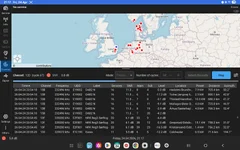
Now, with AbracaDABra, I can perform a single channel scan and identify the TII (Transmitter Identification Information) of all TXs being received for my selected channel block.
Alternatively, I can scan all channel blocks or just selected channel blocks and AbracaDABra will list all TXs received for each active channel.
In the tropospheric enhancement (lift) of a couple of weeks ago, I received Norway, Denmark, Holland, Germany, Belgium and France, all easily identified thanks to AbracaDABra.
If you want to try it, in addition to AbracaDABra, you will need an RTL SDR (or similar Software Defined Radio) dongle, a USB OTG (On The Go) cable to connect the dongle to tablet or phone, plus some form of DAB antenna.
Come and join me DAB/DAB+ DXing, it is great fun.
Best regards to all, John.
It has completely changed my DAB DXing and is an absolutely super app.
I have been DAB(and DAB+) DXing (listening for distant DAB radio signals) for almost as long as DAB radio has been broadcast.
Up until now, the biggest problem has been identifying which TXs (transmitters) I am receiving.
DAB uses what are called SFNs (Single Frequency Networks), where a receiver may receive signal from a number of TXs in the network and all signals should be additive and enhance the overall reception.
However, this gives problems with DX reception as identifying which TXs are being received is not possible with a normal domestic receiver.
I did use an old Arcam DT81 for a while but this can only perform auto-scans and is very slow.
Now, with AbracaDABra, I can perform a single channel scan and identify the TII (Transmitter Identification Information) of all TXs being received for my selected channel block.
Alternatively, I can scan all channel blocks or just selected channel blocks and AbracaDABra will list all TXs received for each active channel.
In the tropospheric enhancement (lift) of a couple of weeks ago, I received Norway, Denmark, Holland, Germany, Belgium and France, all easily identified thanks to AbracaDABra.
If you want to try it, in addition to AbracaDABra, you will need an RTL SDR (or similar Software Defined Radio) dongle, a USB OTG (On The Go) cable to connect the dongle to tablet or phone, plus some form of DAB antenna.
Come and join me DAB/DAB+ DXing, it is great fun.
Best regards to all, John.
Attachments
Last edited: